Untitled
2019
two-channel 4K video
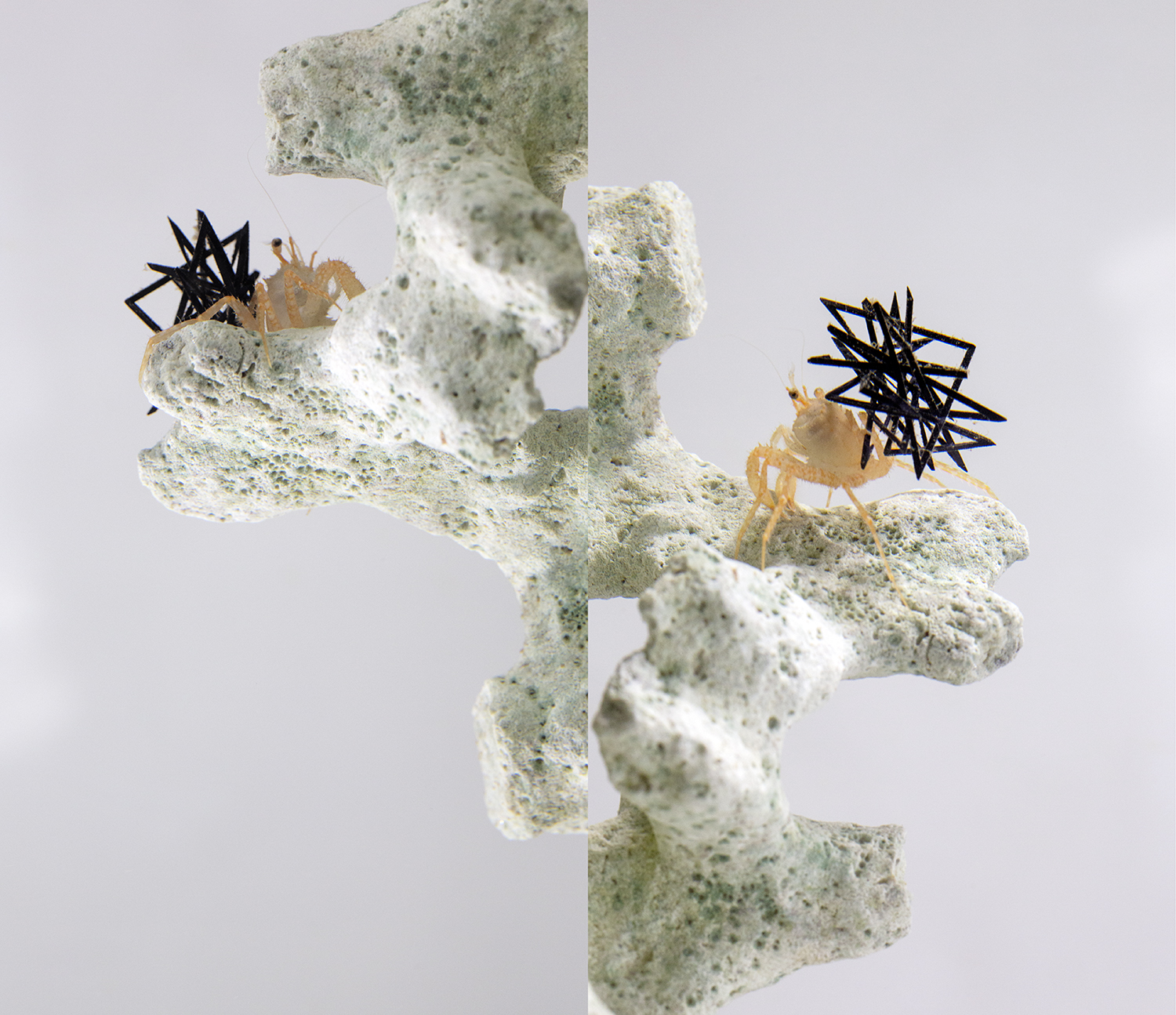
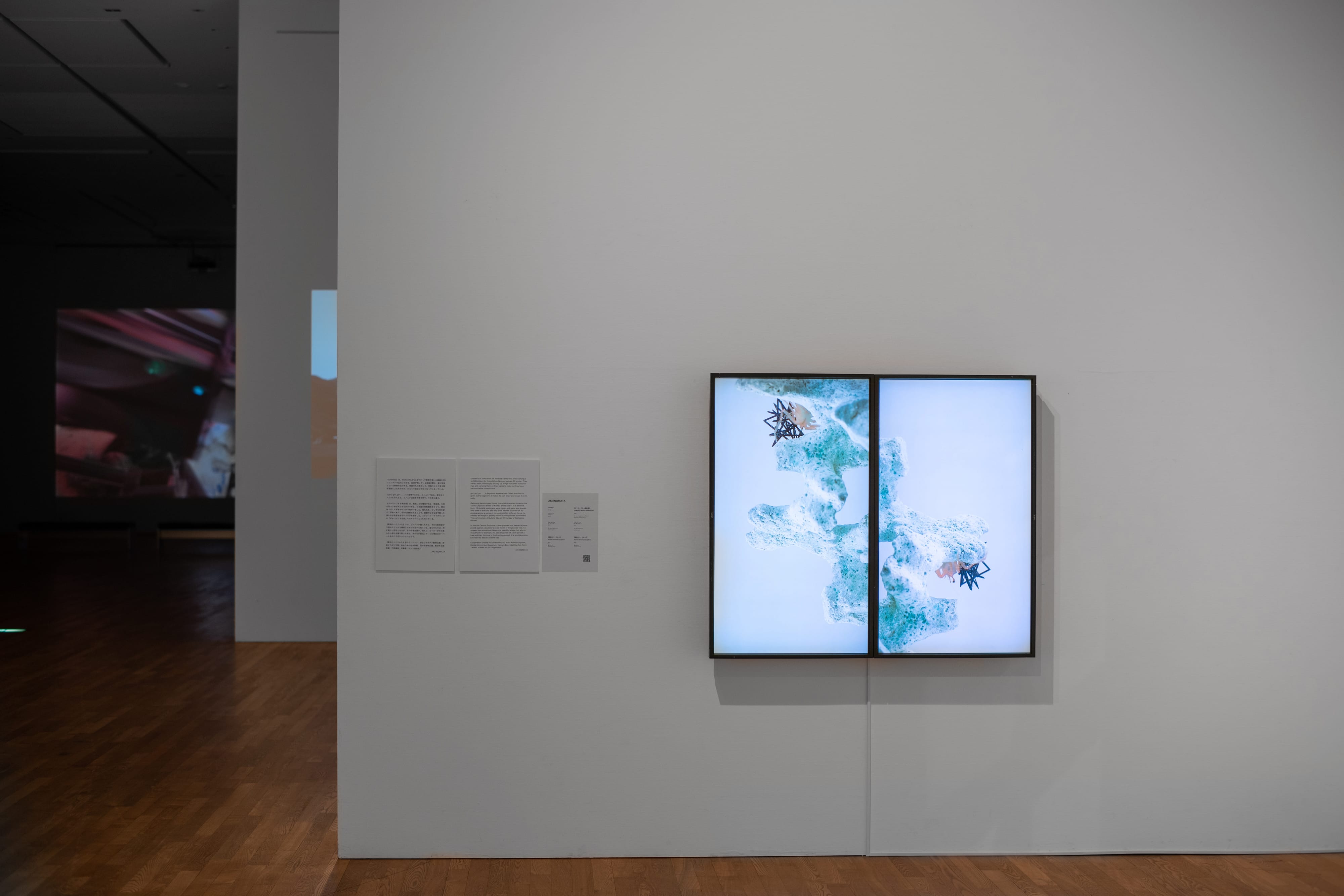
My collaborator in this work is a species of deep-sea crab known as Tōyō-homora (Homola orientalis). Homola crabs have the habit of picking up fragments found on the seafloor—such as pieces of sea sponge, coral, and shells—and carrying them on their backs as a form of camouflage. Their rearmost pair of walking legs is shaped like hooks, enabling them to hold and carry on their backs the objects they collect from the seabed. I drew lines like doodles in a computer-generated space, converted them into 3D data, and then 3D-printed them. When I placed these forms in the tank where I keep the Homola crab, it picked one up and carried it on its back, almost as if it had been waiting for it.
Just as space debris drifts through outer space, the internet is also accumulating remnants of data that have lost their meaning or purpose. I see these fragments as a kind of debris scattered across the seabed of online space. Digital fabrication technology has made it possible to output data that once existed only as information into physical space by connecting a computer to fabrication tools. Behind this work is a premonition that such fragments may one day flow into the real world and begin to affect our bodies and environments.
In this work, I visualize, through the living body of the Homola crab, an unsettling premonition—and even a dystopian future—in which the sea of information space and the actual sea become connected. Lines that emerged by chance in virtual space are transformed through 3D printing into a kind of drifting object, appearing on the back of a deep-sea crab. The Homola’s act of protecting itself through mimicry and camouflage seems, paradoxically, to become an act of self-display when it selects and carries an artificial, conspicuous object. While humorous, this reversal also suggests the possible impact of human presence and digital technology on the behavior and environments of other species.
この作品で協働しているのはトウヨウホモラという深海に棲むカニの一種である。ホモラには、海底に落ちている海綿、珊瑚のかけら、貝殻などを拾い集め、それらを背負うことで身を隠そうとする習性がある。最後方の歩脚はカギ爪のような形状をしており、それによって海底で拾い集めたものを背中に担ぐことができる。私は、CG上で落書きのように線を描き、それを3Dデータへと変換し、3Dプリントした。その形態をホモラを飼育する水槽に入れたところ、ホモラはまるでそれを待っていたかのように拾い上げ、背負った。
宇宙空間に漂うスペースデブリのように、インターネット空間にもまた、意味や目的を失ったデータの残滓が蓄積している。私はそれらを、ネット空間の海底に散逸するデブリ(残骸)として捉えている。デジタルファブリケーション技術は、情報でしかないデータを、PCと工作機器を接続することで、現実空間へと出力することを可能にした。それらがいつか現実の空間へと流れ込み、私たちの身体や環境に影響を及ぼし始めるのではないかという予感が、この作品の背後にある。
本作では、そうした情報空間の海と現実の海がつながってしまうことへの不穏な予感やディストピア的な未来を、ホモラの生きた身体を通して可視化している。仮想空間で偶発的に生まれた線は、3Dプリントによって一種の漂流物となり、深海に棲むカニの背中に現れる。周囲に擬態し、カモフラージュすることで身を守ろうとするホモラの行為が、人工的で目立つものを選び取って担いでしまったことで、むしろ自らの存在をアピールしているようにも見える。この逆説はユーモラスでありながら、人間の存在やデジタル技術が、他種の生きものの行動や環境に及ぼしうる影響を示唆している。